The problem with color-keying technology is in its imperfection. Color is very sensitive – if there is a green glow on your character or a glimmer of green mingled in their hair you could spend hours touching up single frames to perfect the shot.
I thought to myself “there’s got to be an easier way to do this,” and promptly came up with a genius idea: what if you could use the z-axis? See, two-dimensional photos have of course and x-axis and a y-axis. But in the world of 3-D graphics you’re blessed with a scale that measures depth – the z-axis. As far as I knew there were no cameras capable of capturing that depth information at the pixel level. If only there was a way – you could key out backgrounds with the click of a button.
Well, I must have been caught up in some photographic zeitgeist because the next day I saw a video of a new prototype camera that could capture depth information, beating me to the millions I deserved for thinking up something totally innovative. Now Adobe is pimping the technology out all over the place.
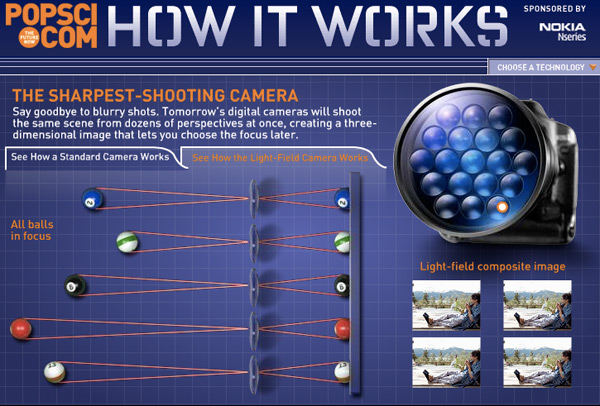
 The prototypal camera has 19 distinct lenses – a plenoptic lens that looks like a fly’s eye – and a very very beta computer program that renders the image. See the video demo here.
The technology is wicked hard to understand – but I’ll try: Each mini-lens of the plenoptic camera takes a picture that is slightly different in focus and perspective. Adobe’s super-secret computer application then combines the smaller images into one big image, interpreting the minor differences between the images – the degree of focus and perspective – into meta data: depth information.
Having depth information for a photo is an astounding achievement. It means you can put things in focus that were previously out of focus. It also means you can “key” out portions of the image are of a certain depth. Did your son come out to blurry in that family shot in front of the Empire State Building? Use a deblur brush! You want to get rid of your ex-wife but keep the shot of the Grand Canyon? Make her disappear using depth info!
These cameras are a long way from practicality. It takes a ton of computing power to render depth data. The ability to incorporate this into video tech is even further off – meaning that if CG artists want to composite they’ll still have to rely on good ol’ fashioned green screen – or find some more efficient way of capturing depth info (email me, I have a few ideas for the right price…).
But Adobe thinks the tech will prove useful to the professional photog in the meantime. Prepare to see Papparazi taking photos of Angelina Jolie’s stomach from 19 different POVs within the decade!
 the Blanket Statement